
Dyson’s £970 Million Warning:
Why Premium Engineering Cannot Outrun Poor Customer Service.
by Denis Huré
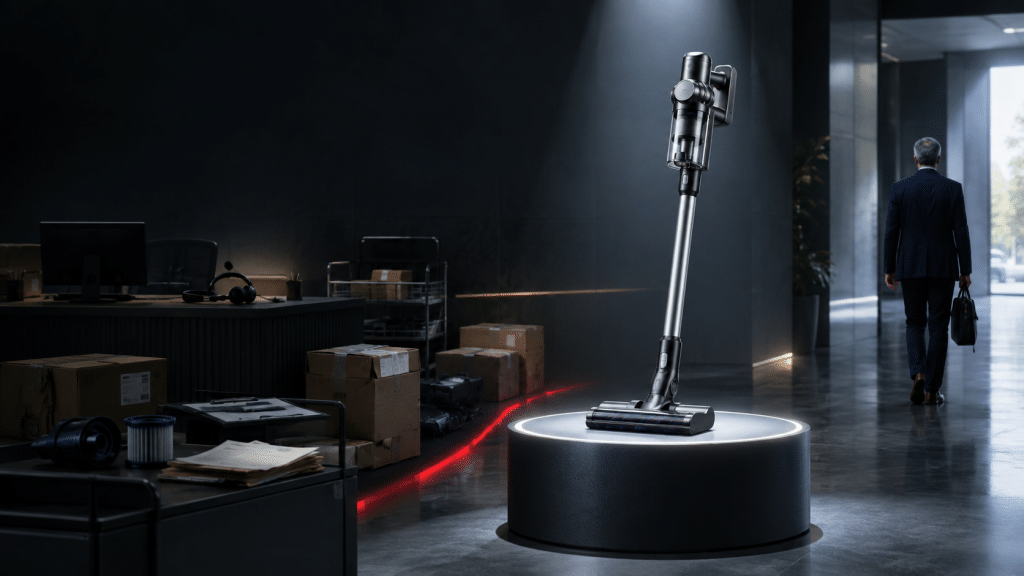
Dyson is not dying today. But it is moving in a dangerous direction: behaving as if exceptional engineering can indefinitely compensate for an inconsistent post-purchase experience. It cannot.
I did not begin investigating Dyson as a detached observer. I began as a long-standing Dyson fan whose latest purchase produced such a poor customer experience that admiration turned into refusal: I became a Dyson boycotter. That personal experience is not proof of a systemic failure. It is the reason I started digging—and what I found suggests that the gap between Dyson’s premium promise and its service reality deserves board-level attention.
The new reveal
The usual explanation for Dyson’s success is product innovation: better motors, distinctive industrial design, visible engineering and the confidence to charge premium prices. The new reveal is that Dyson’s next existential product may not be another vacuum cleaner, hair tool or AI-enabled device. It may be its service operating model.
Dyson’s revenue fell from £7.1 billion in 2023 to £6.57 billion in 2024 and £6.13 billion in 2025—a decline of approximately £970 million, or nearly 14%, in two years. This does not prove that poor customer service caused the decline. Dyson attributes its recent performance to tariffs, adverse currency movements, weak consumer confidence, supply disruption, restructuring, competition and a deliberate rebalancing from direct retail towards key retail partners.
That distinction matters. A credible critique should not turn correlation into causation. Yet the absence of public causal data does not make customer experience irrelevant; it reveals a strategic blind spot. Dyson does not publicly disclose enough information on complaint rates, first-contact resolution, repair turnaround, customer effort, satisfaction after service incidents, repeat purchasing or customer lifetime value to show investors and customers whether the relationship engine behind the premium brand is healthy.
The warning is therefore not simply that revenue has fallen. It is that revenue has fallen while publicly visible service signals suggest Dyson may be eroding the customer loyalty it will need to recover.
Product excellence is insufficient
The old premium-brand model says: build an exceptional product, protect the design, tell a compelling innovation story and customers will pay more. The emerging model says something harsher: the product wins the first transaction, but the experience determines whether the company keeps the customer.
This is especially important for Dyson because it has become an omnichannel, direct-to-consumer-enabled manufacturer. When Dyson sells directly, it owns the promise from end to end: checkout, delivery, troubleshooting, returns, warranty, repair, parts, replacement and refund. There is no retailer to absorb the frustration or rescue the relationship.
That changes the economics of a service failure. A malfunctioning machine is one problem; a customer forced through repeated scripts, delayed logistics, inconsistent answers or unresolved escalation experiences a second product failure—the service itself. At a premium price, that second failure can feel less like inconvenience and more like betrayal.
PwC’s 2025 survey of 5,511 consumers found that 52% had stopped using or buying from a brand because of a bad product or service experience, while 29% had stopped because of poor customer experience online or in person. Qualtrics’ global research found that service-delivery and communication failures were the two most frequently cited causes of bad experiences, and that more than half of negative experiences led consumers to reduce or stop spending with the organisation. These figures do not quantify Dyson’s losses, but they establish the commercial mechanism: bad experiences can destroy retention, cross-sell and advocacy even when the original product remains admired.
This is precisely how a fan becomes a boycotter. The company does not merely lose one disputed purchase. It risks losing the next vacuum, the next hair tool, accessories, replacement parts, recommendations and the benefit of doubt when a new category launches.
The public warning signals
Dyson’s UK Trustpilot profile currently shows a 2.8 out of 5 rating across roughly 37,000 reviews. Trustpilot’s own summary highlights dissatisfaction involving unhelpful agents, difficult returns, exchanges and warranty claims, long waits, unfulfilled callbacks, delivery problems and inconsistent problem-solving; the profile indicates responses to only 20% of negative reviews.
The contrast with relevant competitors is difficult to ignore. Shark Clean UK shows 4.5 out of 5 across more than 50,000 reviews and reports responding to 99% of negative reviews, while Miele Great Britain has been indexed at 3.8 out of 5 and a 98% negative-review response rate. These are not laboratory-quality measures: review sites are self-selecting, profiles may cover different channels, and brands may use different review-invitation practices. But a premium company should not dismiss a large and persistent perception gap merely because the dataset is imperfect.
The US picture adds another directional signal. The Better Business Bureau listed 3,088 complaints against Dyson Inc. over the preceding three years and 550 closed in the previous 12 months in its September 2026 snapshot. Without a denominator for Dyson’s US orders or installed base, these numbers cannot be converted into a complaint rate. They can, however, be treated as evidence of repeated escalation and operational friction.
|
Signal |
Dyson |
Relevant contrast |
Responsible interpretation |
|
UK Trustpilot rating |
2.8/5; about 37,000 reviews |
Shark Clean UK: 4.5/5; over 50,000 reviews |
Directional evidence that Dyson’s public experience reputation materially trails a major competitor |
|
Negative-review response |
20% |
Shark: 99%; Miele: 98% |
Suggests a large difference in visible service recovery, though response alone does not prove resolution |
|
US BBB complaints |
3,088 over three years |
No like-for-like denominator |
Escalation signal, not a defect or complaint rate |
|
Revenue trend |
£7.1bn to £6.13bn, 2023–2025 |
Nearly £970m lower |
Material deterioration, but not attributable to service from public evidence |
For a mass-market brand, poor service is damaging. For a premium brand, it attacks the justification for the premium itself. Customers are not only paying for engineering specifications. They are paying to reduce risk: risk of choosing badly, risk of product downtime and risk of being abandoned when something goes wrong.
The strongest defence
There is a serious opposing case, and it should be heard fairly.
First, Dyson continues to sell at enormous scale. It sold more than 20 million products in 2024—a record volume—even as revenue declined. Second, 2025 profitability improved: EBITDA rose 18% to £1.11 billion and operating profit rose 15% to £600 million, despite revenue falling to £6.13 billion. A company increasing profit, launching 13 products in a year and continuing significant research investment is not on the verge of financial collapse.
Third, external shocks are real. Dyson says US tariffs were particularly damaging, while currency movements and low confidence in the US, Germany and China weighed on performance. Its 2024 results were also affected by a Philippine factory fire that constrained beauty-product supply and by organisational restructuring. It would be analytically weak—and unfair—to relabel all of these effects as customer-service failure.
Fourth, online reviews overrepresent unhappy customers. They cannot tell us how many millions of Dyson owners are satisfied, how complaint rates compare per thousand units, or whether people who complain eventually receive an acceptable resolution. Dyson also offers seven-day support, central repair collection, a £99 out-of-guarantee UK repair price covering labour and required parts, and a loan-machine programme where eligible repairs at participating locations exceed three days.
All of that is true. It is also not enough.
Profit improvement driven partly by cost reduction can coexist with weakening customer relationships. Record unit volume alongside falling revenue may indicate mix, pricing, foreign exchange or channel effects; it does not prove brand health. And a published service promise has strategic value only when the customer experiences it consistently.
The correct conclusion is not “bad service caused Dyson to lose £970 million.” The defensible conclusion is more important: Dyson has lost nearly £1 billion in annual revenue compared with 2023, while visible customer-service weaknesses create an additional, unquantified threat to retention, pricing power and future growth.
Why urgency is rising
The timing matters because Dyson is expanding the number and complexity of relationships it must support. Vacuums, hair care, air treatment, robotics, audio and connected devices create different diagnostic paths, spare-parts requirements, software dependencies and customer expectations. Launch velocity without service readiness can convert innovation from an advantage into a growing operational burden.
Regulation is also resetting expectations. The EU Right-to-Repair Directive has applied through Member State rules since 31 July 2026. It gives consumers rights to request repair for covered, technically repairable products at a reasonable price and within a reasonable period; vacuum cleaners are explicitly among the covered product categories. The Directive also extends the legal guarantee by at least 12 months when eligible consumers choose repair rather than replacement, and the EU expects an online repair platform to operate in 2027.
This should not be misrepresented as an unlimited right for every consumer to open every product or obtain every internal component. Safety, intellectual property and product-specific requirements still matter, and the repair obligation applies within the scope of relevant EU repairability rules. Strategically, however, the direction is unmistakable: accessible parts, transparent repair options, reasonable pricing and non-obstructive repair systems are becoming components of the product proposition rather than after-sales extras.
Dyson can treat this as compliance cost—or use it to reinvent premium ownership. The second choice would be far more consistent with its history.
The road to decline
A premium brand rarely dies because everyone suddenly agrees its products are bad. It declines through a slower chain reaction:
- Product desirability continues to generate first purchases.
- Service failures create friction at the moment of greatest customer vulnerability.
- Previously loyal owners defer replacement, migrate to competitors or buy through retailers for greater protection.
- Negative advocacy raises acquisition costs and weakens conversion.
- Management responds to softer growth with more launches, promotions or cost reduction.
- Greater complexity and lower service investment create more inconsistent experiences.
- The brand retains awareness but loses trust—and eventually its premium.
Dyson’s products can remain technically excellent throughout much of this process. That is what makes the risk easy to underestimate. Brand decline is not always visible in innovation awards or unit sales; it often appears first in the willingness of established customers to buy again without hesitation.
A constructive recovery plan
Dyson does not need a cosmetic customer-care campaign. It needs to treat ownership experience as an engineered system with the same seriousness it applies to airflow, motors and industrial design.
Make service a product
Create a board-owned Dyson Ownership System spanning delivery, onboarding, diagnostics, repair, parts, loaners, returns, refunds and upgrades. Give it a product leader, a roadmap, a dedicated investment envelope and authority across markets. The design goal should be simple: when a machine fails, the recovery experience should reaffirm why the customer paid a premium.
A premium service proposition could include:
- One case owner from first contact to resolution.
- A visible service timeline with proactive updates.
- Immediate escalation when promised actions fail.
- Repair-or-replacement decisions based on transparent rules.
- Published refund and repair turnaround commitments.
- Automatic goodwill when Dyson misses its own promise.
- Loan products for high-dependency categories and lengthy repairs.
- A complete digital record transferable with the product to support resale and circularity.
Publish the truth
Dyson should disclose a concise annual customer-experience scorecard. At minimum, it should publish first-contact resolution, median and 90th-percentile repair time, parts fill rate, refund cycle time, repeat-contact rate, post-resolution satisfaction and complaint volumes per thousand active machines.
Publication creates accountability, but it also creates credibility. A company confident enough to show 5,127 prototypes before achieving a breakthrough should be confident enough to show how many service iterations are required to perfect ownership.
Measure revenue at risk
The company should link service data to customer economics rather than treating complaints as a contact-centre cost. A matched-cohort analysis can compare customers who experienced delivery, warranty, repair or refund failures with similar customers who did not, then measure repurchase, cross-category purchases, accessories, referrals, returns and support costs over 6, 12 and 24 months.
The essential equation is straightforward:
Service-attributable value at risk = affected customers × incremental churn or spending reduction × expected customer lifetime value.
This would allow Dyson to distinguish a vocal but economically contained issue from a material loyalty failure. Public evidence cannot make that calculation; Dyson’s own data can.
Empower resolution
Premium recovery requires judgement, not endless escalation. Frontline teams should receive clear financial authority to replace components, authorise returns, expedite shipments and grant goodwill within defined risk limits. Automation and AI should retrieve product history, summarise previous contacts, predict likely faults and recommend the next best resolution—but a human must remain accessible when the customer is trapped or the case falls outside standard logic.
The objective should not be the cheapest contact. It should be the lowest total cost of a durable resolution, including retained lifetime value.
Open the repair ecosystem
Dyson should go beyond minimum compliance by creating a European repair portal for covered products, with transparent parts availability, indicative prices, repair manuals, diagnostic access and a qualification route for independent repairers where safety demands competence. Its existing central repairs, selected spare-parts sales and loan-machine initiative provide useful foundations.
The opposing concern is legitimate: uncontrolled repair can create electrical, battery, safety, counterfeit and intellectual-property risks. The answer is not to block repair; it is to engineer a trusted ecosystem through technician certification, authenticated parts, auditable diagnostics and clear liability boundaries. That would expand service capacity without abandoning safety or brand control.
Reward recovered trust
Service recovery should feed a relationship programme rather than end with a closed ticket. Customers who endure a significant failure could receive an extended warranty, priority support, maintenance credit, accessory, trade-in protection or carefully designed recognition—not as hush money, but as proof that loyalty has value.
The programme must reward restored confidence rather than indiscriminate spending. A customer whose issue was resolved brilliantly can become more loyal; one who receives a discount while the underlying problem remains unresolved becomes a subsidised detractor.
The board-level choice
Dyson still possesses what most companies would envy: global recognition, engineering credibility, distinctive design, premium pricing and the capacity to launch new categories. Its higher 2025 EBITDA and operating profit show financial resilience, not imminent death. That is the constructive opportunity.
But resilience can become complacency. The company cannot assume that customers will continue separating the brilliance of the machine from the frustration of owning it. In a direct relationship, customer service is not downstream from the brand. It is the brand at the exact moment the promise is tested.
My experience turned one Dyson fan into a Dyson boycotter. The public evidence cannot tell us how many others have made the same transition silently. PwC found that consumers often stop buying after bad experiences, while Qualtrics found that a substantial share simply reduce or end their spending. By the time that behaviour becomes fully visible in revenue, the relationship has already been lost.
Dyson’s near-£1 billion revenue decline is therefore not proof of a customer-service collapse. It is a warning arriving at the same time as powerful evidence of service friction, stronger competitors and rising repair expectations. The road back is available: engineer the ownership experience, publish its performance, empower recovery and make repair a premium advantage.
The alternative is to keep building remarkable products for an installed base that increasingly admires the technology—and buys somebody else’s.
How TLA&C can help
TLA&C helps boards and executive teams turn customer-experience risk into measurable commercial action. We can map Dyson-style end-to-end ownership journeys; benchmark service performance and competitor propositions; quantify revenue and customer-lifetime-value at risk; design AI-enabled but human-accountable service operations; create repair, retention and service-recovery strategies; and establish the executive dashboards and governance needed to make customer experience a board-level growth system rather than a support cost.
Bibliography
- Better Business Bureau. “Dyson, Inc. Complaints.” September 2026. https://www.bbb.org/us/il/chicago/profile/wholesale-vacuum-cleaners/dyson-inc-0654-33004452/complaints
- “Dyson 2023 Financial Results.” https://www.dyson.co.uk/discover/news/press-releases/dyson-financial-results-2023
- “Dyson 2024 Results: Record Volumes Despite Challenging Conditions.” 28 September 2025. https://www.dyson.co.uk/discover/news/press-releases/dyson-financial-results-2024
- “Dyson 2025 Results: Tariffs and Currency Hit Hard, but Dyson Grows EBITDA.” 7 April 2026. https://www.dyson.co.uk/discover/news/press-releases/dyson-financial-results-2025
- “Experience and Own the Latest Technology During Repairs.” 4 March 2026. https://www.dyson.co.uk/discover/news/latest/never-without-your-dyson
- “Repairs and Servicing Information.” https://www.dyson.co.uk/support/repairs-and-servicing-information
- “Support: Contact Us.” https://www.dyson.co.uk/support/contact-us
- European Commission. “Directive on Repair of Goods.” https://commission.europa.eu/law/law-topic/consumer-protection-law/directive-repair-goods_en
- European Commission. “Obligation to Repair: Questions and Answers.” https://commission.europa.eu/document/download/2d443b31-dc2a-4e54-a9ec-5fbb61c895e9_en?filename=2024_07_18_QA_Right2repair_FINAL.pdf
- European Commission. “Right to Repair: New Consumer Rights for Easy and Attractive Repairs.” 31 July 2026. https://commission.europa.eu/news-and-media/news/right-repair-new-consumer-rights-easy-and-attractive-repairs-2026-07-31_en
- European Union. “Directive (EU) 2024/1799 on Common Rules Promoting the Repair of Goods.” EUR-Lex, 10 July 2024. https://eur-lex.europa.eu/eli/dir/2024/1799/oj/eng
- “The Loyalty Illusion: 2025 Customer Experience Survey.” 2025. https://www.pwc.com/us/en/services/consulting/commercial-excellence/library/2025-customer-experience-survey.html
- Qualtrics XM Institute. “Bad Experiences Across 20 Industries, 2025.” 2025. https://www.qualtrics.com/research/bad-experiences-2025/
- Qualtrics XM Institute. “Businesses Risk $3 Trillion in Sales from Poor Customer Experiences.” 10 December 2025. https://www.qualtrics.com/news/businesses-risk-3-trillion-sales-poor-customer-experiences-consumers-cut-spending/
- “Dyson UK Reviews.” Accessed 17 September 2026. https://www.trustpilot.com/review/www.dyson.co.uk
- “Miele Great Britain Reviews.” Accessed 17 September 2026. https://www.trustpilot.com/review/www.miele.co.uk
- “Shark Clean UK Reviews.” Accessed 17 September 2026. https://www.trustpilot.com/review/sharkclean.co.uk
References
- DYSON 2025 RESULTS: Tariffs and currency hit hard, but Dyson … – Dyson’s 2025 Financial Results in brief: Revenue: £6.13bn (2024: £6.57bn) EBITDA climbing to £1.11 b…
- DYSON 2024 RESULTS: Record volumes despite … – Dyson sold more products than ever before in 2024 – in excess of 20 million globally – while overcom…
- Dyson delivers record revenues and grew its R&D … – Following record investments, Dyson has entered 2024 poised to launch its biggest-ever line up of ne…
- Dyson suffers £440m sales hit from ‘damaging’ Trump tariffs – The company said it was affected by low consumer confidence in the US, Germany and China, although i…
- Dyson profits halved in ‘difficult’ year despite record sales … – Slower economic growth and reduction in consumer confidence in some key markets were behind the decl…
- The loyalty illusion: PwC 2025 Customer Experience Survey – Survey shows why companies think they’re winning when customers are walking away.
- Global Study: Bad Experiences Across 20 Industries, 2025 – Consumers reported that 12% of recent experiences were very poor, ranging from 22% among government …
- Read Customer Service Reviews of www.dyson.co.uk – Read 21-40 Reviews out of 37589. Clients share negative opinions on customer service, s consistently…
- Shark Clean UK Reviews | Read Customer Service … – People report positive experiences with quality, highlighting excellent performance and build. This …
- Miele Great Britain Reviews | 2 of 466 – Trustpilot – 2026 Rated 4 out of 5 stars ・ 99% of negative reviews ・ pilot See how their reviews and ratings are …
- Dyson, Inc. | BBB Complaints | Better Business … – View complaints of Dyson, Inc. filed with BBB. BBB helps resolve disputes with the services or produ…
- Support | Book a repair – Dyson – Need a repair? We’ll fix your machine the same day in select stores and service centres, or provide …
- Experience and own the latest technology during repairs – Dyson – Never without your Dyson: Experience and own the latest technology during repairs … If your Dyson …
- Support | Contact Us – Expert customer service, 7 days a week. Call our UK based helpline, WhatsApp or chat online. visit o…
- Directive on repair of goods – European Commission – Member States have to transpose it into national rules and apply it from 31 July 2026. This instrume…
- Right to repair: New consumer rights for easy and attractive repairs – This will change, starting on 31 July 2026, when it will be possible to extend the lifecycle of prod…
- [PDF] Obligation to repair – European Commission – The extension of the legal guarantee applies only to goods bought as from. 31 July 2026. When transp…
- Directive – EU – 2024/1799 – EN – EUR-Lex – Directive (EU) 2024/1799 of the European Parliament and of the Council of 13 June 2024 on common rul…
- [Businesses Risk $3 Trillion in Sales From Poor Customer …](https://www.qualtrics.com/news/businesses-risk-3-trillion-sales-poor-customer-experiences-consumers-cut-spending/) – Poor customer experiences could cost businesses nearly $3 trillion in sales globally as customers cu…
About Denis Huré
Denis Huré is the founder & Managing Consultant of TLA&C. His consulting practice is grounded in first-hand entrepreneurial experience, having built, scaled, and operated businesses himself; he brings a founder’s instinct for what actually works alongside the strategic rigor of a seasoned consultant. Denis brings also a rare combination of strategic innovation, platform architecture expertise, and hands-on business building to consulting assignments. He advises organizations on how to modernize their technology base, reduce structural dependency on vendors, and translate emerging capabilities such as AI, compliance tooling, and advanced payment models into scalable commercial outcomes. TLA&C – Denis Huré
Researched and drafted with AI assistance, edited and fact-checked by the author. Illustration: AI-generated.